Program Design
Student Success Tools · Case study
The Animation and Digital Media Arts programs are backward-designed from what industry actually hires for, with an advisory board setting the target and the curriculum, courses, and credentials built to reach it, then streamlined with enrollment and staffing data so students can finish.
Goal
Design the program, not just the courses. A close, ongoing industry advisory board reviews the curriculum, looks at students’ final portfolios, and hosts the internships, then says plainly what a graduate’s portfolio has to contain, what software students must know, and what workplace skills get them hired. Everything downstream is built from that target.
Audience
Two audiences at once. Students, who need to finish with a portfolio that actually gets them hired and a path they can realistically complete in two years. And the institution, which funds programs on enrollment, completion, and workforce outcomes.
Process
From the advisory board’s target, the required skills are chunked and mapped across the whole program: parsed into existing courses, or turned into new courses and credentials where there is a gap. Every course is then aligned to the portfolio, so students build one portfolio across the entire program rather than a pile of disconnected assignments. The redesigned AVC 100 starts that chain by setting up each student’s portfolio account in the first course.
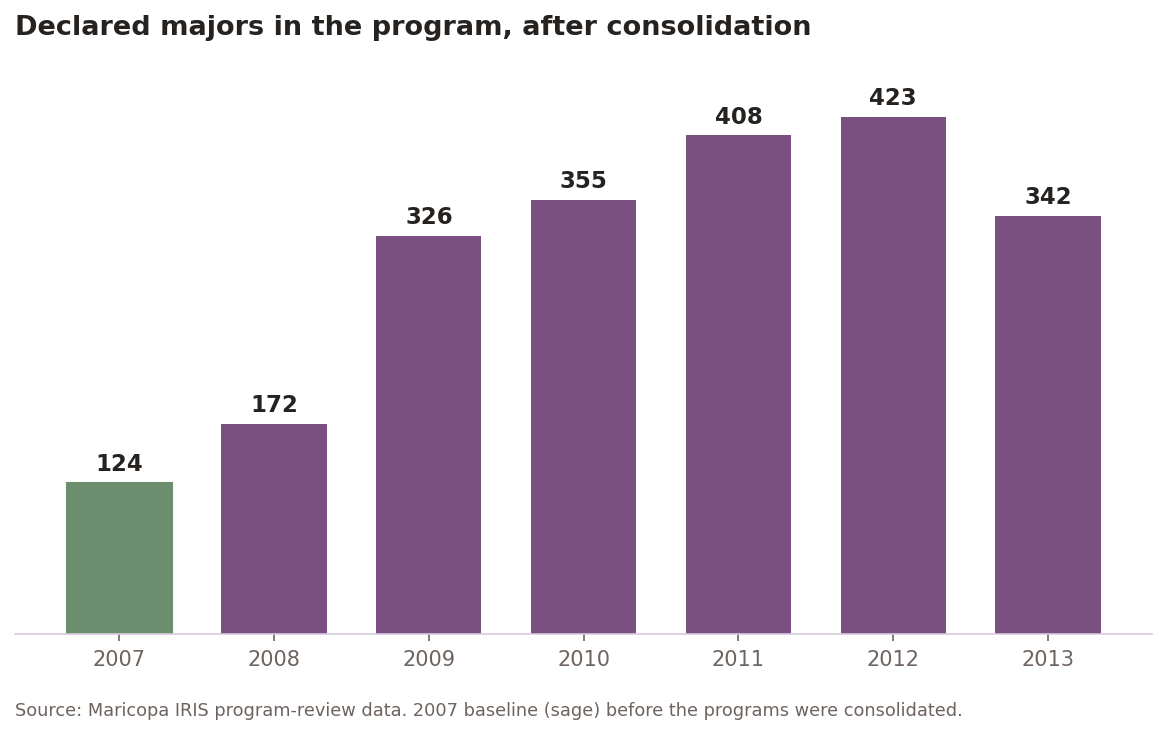
The same evidence habit runs the program’s structure. The discipline was once split into several small programs, separate Animation, Multimedia, and Graphic Design degrees plus two web certificates, and the narrow, low-enrollment courses meant students often could not get the classes they needed and stalled short of graduating. Consolidating them into a broader Digital Media Arts degree, combining low-enrollment courses, and later adding online and mixed-modality sections meant students could finally complete, while the hybrid shift helped keep them enrolled through work and family demands. The stackable microcredentials come from the same logic.
The same alignment runs up to the district level. As my department’s representative in Maricopa’s two-year Guided Pathways initiative across all ten colleges, I helped align a course bank that had drifted: ten colleges each building their own way, degrees split across two to four non-adjacent campuses, and students who swirl between colleges needing courses that carry cleanly from one to the next. Aligning district-wide is what lets programs be offered coherently instead of duplicated thinly, and it is where Animation was restored as its own degree.
The read on the field is quantitative too. The programs are checked against Bureau of Labor Statistics occupational data, and that is what is driving the current pivot from a standalone graphic-design track toward a UX Design course: user-experience roles are growing, while graphic-design jobs increasingly expect a bachelor’s degree, which makes a two-year graphic-design credential harder to place. Designing the program means watching where the work is going, not only where it is.
Technology
- The every-three-years program review, backed by Maricopa IRIS enrollment and completion data.
- U.S. Bureau of Labor Statistics occupational data.
- An industry advisory board.
- The district-wide Guided Pathways course bank.
Outcomes
Ongoing program work, as faculty now and earlier as Program Director. The stackable microcredentials are approved and going through the curriculum process, and a new UX Design for Interactive Media course is approved and being built.
Graduation nearly doubled while enrollment stayed roughly flat, so the gain came from students finishing. The program review attributes it to a redesigned advising model with proactive, one-on-one outreach before students drift. Staffing followed the same evidence: a campus-wide comparison of students per full-time faculty across the occupational programs made the case for a second full-time line in a program that had exactly one, and it now runs on three full-time faculty and about five adjuncts. The same case-making helped secure the grant behind the paid design studio, where students work nineteen hours each. Three siloed labs, one each for photography, animation, and graphic design, each with its own technician and each closing at five, became a single central lab staffed by three cross-trained assistants who also covered video and cinema, and it could finally stay open early, late, and on weekends. Industry input on the tools students must learn shaped the space, and the program review made the case.
Digital Media Arts AAS graduates per year · enrollment stayed roughly flat over the same period
The program’s quality shows in what its students win, as program awards rather than any one instructor’s. A student earned a Rocky Mountain Emmy for animation and visual effects. In the Artist of Promise Awards, the Maricopa district-wide competition that draws entries from all ten colleges, the program near-sweeps the Animation category most years, taking the majority of its awards against nine peer institutions. The Traveler has won multiple College Media Association Pinnacle awards.