Intro to Digital Arts redesign
Course Design · Case study
A ground-up redesign of the program’s highest-enrollment, lowest-success course, and a deliberate on-ramp into Digital Arts. Many who take it are new to college and not yet majors, just testing the water, so it is built to make them feel supported, do real work, and want the next course: a recruitment tool for the program as much as a foundation course.
Provenance. Designed and built by hand by Michelle Blomberg, the subject-matter expert. The redesign is driven by institutional data. It stands on its own; I ran it through my skill afterward only to check alignment and accessibility (AI-assisted course design).
“If students feel supported and connected, they will persist.”
Goal
We redesigned AVC 100, Introduction to Digital Arts, around the real reasons students struggle in it, and measured what students actually learned rather than how much content was added. More students finishing was part of the goal. So was the deeper test: whether a student who had never opened Illustrator leaves having produced original work, knowing where to find help, and intending to take the next course.
The central move of the redesign is a student success module inside every course module, a mini first-year experience carried in a one-credit art class, tied to institutional learning outcomes rather than to the course outcomes.
Audience
Students from across the college, not only digital arts majors. Some are new to college, many have never taken a fully online course, and some are just filling a one-credit elective. What they share is landing in a one-credit, half-semester course with a heavy software load to learn, so it has to keep them enrolled and moving through the high-risk early weeks.
That range sits inside a specific population. The college is a Hispanic-Serving Institution: about 44 percent of its students are Hispanic or Latino, many the first in their family to attend college. Basic-needs pressure is real and local: the college’s Dean of Student Life reports that 44 percent of the college students are food insecure. The same classrooms hold adult learners returning to school later in life, student veterans, and a high share of students managing ADHD and other disabilities.
Process
The course runs on three small, connected projects, one in each tool, Illustrator, then Photoshop, then After Effects, carrying a single subject the whole way so the three add up to one cumulative piece rather than disconnected exercises.
A course like this is easy to overbuild, because it puts three professional applications in front of a beginner at once. The scope is held to what the instruction and work hours of a one-credit course actually allow, and each project is sized to reach a real result without the software becoming the reason a student quits. The course also teaches more than which buttons to press: students learn a working process, sketching on paper before they touch the computer, the vocabulary of the field, and the transferable basics of design and image-making that carry across any tool.
It ends in a finished project they post to their own portfolio, the same portfolio they keep building in every course after this one. Every project closes with the same four-step critique on Discord: post early, give feedback to at least four classmates, log the feedback given, then submit the final board.
Each student success module is a short video introducing a place students can go when something goes wrong: advising, tutoring, disability services, and the campus basic-needs hub. They are deliberately brief, they are worth easy points, and they ask the student to do one small real thing, such as look up an advisor or find the hours for a service.
They are in the course because the students facing the most barriers, food insecurity, work and family obligations, undiagnosed disability, being the first in the family to attend college, are usually the least likely to know that help exists or to go find it on their own. Optional support is least used by exactly the students who need it most, so this course builds it in.
Three of the videos students meet:
- GCC Cares, the campus basic-needs hub, covering food, emergency assistance, and other support.
- Why advising matters, what an advisor actually does and why to see one before registering.
- Tutoring, presented by Fabio Bruzzese, on what tutoring is and how to use it.
The design draws on the persistence literature, Tinto on integration and Astin on involvement, and on institutional survey data on why students leave.
Technology
- Learning-science foundation: backward design from measurable outcomes, constructive alignment of assessment to those outcomes, Universal Design for Learning, and the persistence research behind the embedded support sequence.
- Built as an IMSCC package that imports into any Canvas LMS shell, so another instructor can adopt it without rebuilding.
- WCAG 2.1 AA accessibility audited in Canvas with YuJa Panorama and CidiLabs UDoIt.
- Instructional video recorded and captioned in Canvas Studio, so every instructor video is accessibility-checked.
- Tableau institutional-research dashboards, which flagged AVC 100 as a high-enrollment, low-success course and set the priorities for the rebuild.
- Assessment on real instruments: a Google Forms pre-and-post survey mapped to the course outcomes, built and deployed with Google Apps Script, and Canvas analytics for participation and grade trends, read every term.
- Student-facing tools: Adobe Illustrator, Photoshop, and After Effects.
- Discord and Miro for critique, planning, and community.
Outcomes
Built and taught, and still in iteration. The survey and reflection below are from the first sections.
The student-support sequence carries the college’s Personal and Community Well-Being outcome, whose criterion asks that a student demonstrate how to access institutional resources. That is precisely what those touchpoints already require, so the rubric simply states what the work was for. It is worth doing here rather than in a capstone: an outcome assessed only inside the major produces data describing majors alone, and this course is full of students who will take one art class and never take another.
The redesign is evaluated against its stated aims rather than against completion counts alone, using a pre and post design.
There is early completion evidence as well. Across two small sections, the share of students who finished rose from 44 percent to 60 percent after the redesign. It is a small sample and a modest gain, but it moved in the direction the redesign intended, and the fuller before-and-after will come from Institutional Research.
An end-of-course survey was administered to the first section in its final week. A week-one baseline is added so that subsequent cohorts can be compared against their own starting point.
These responses come from the students who completed the survey, and are one strand of evidence, read alongside the reflection below and the persistence research the design rests on, rather than a full account of the course’s effect.
Opening the software felt intimidating · lower is better
I know where to go for help at the college
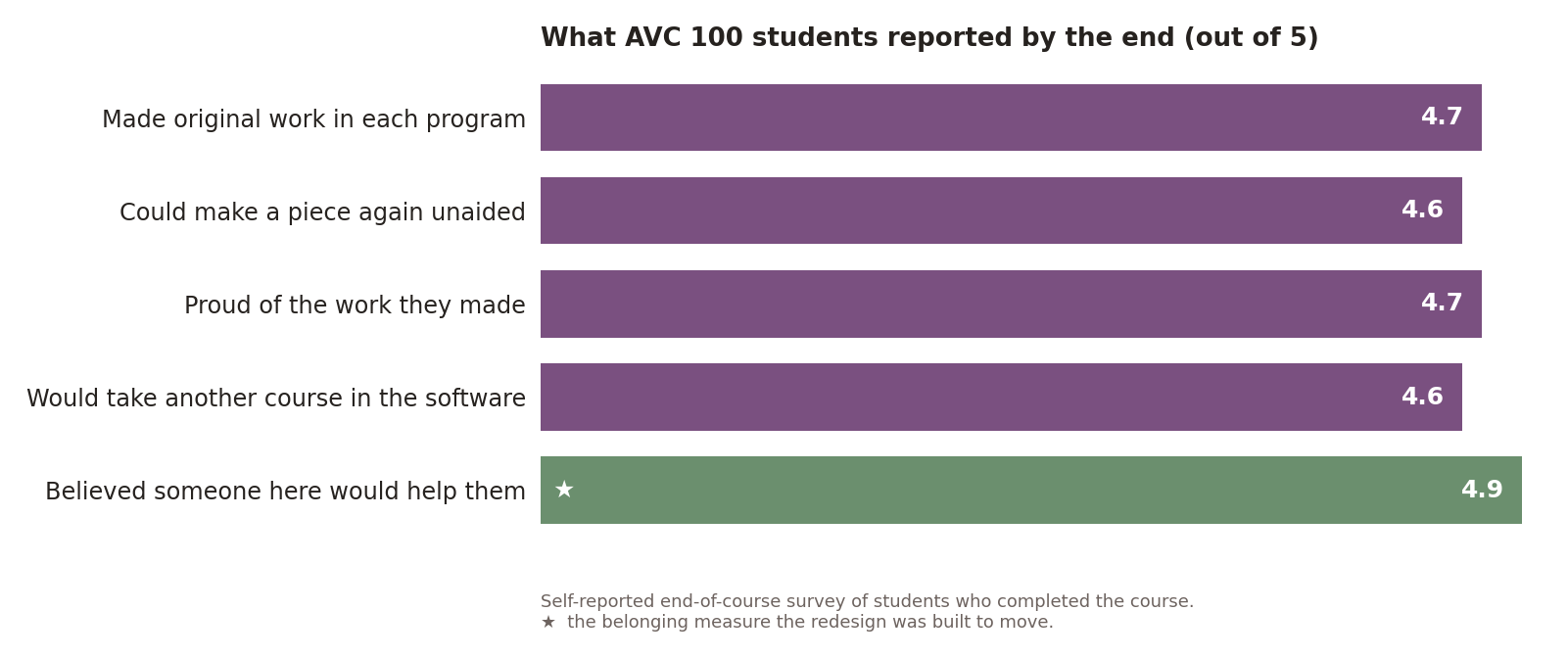
End-of-term measures of confidence, intent to continue, and belonging were also high.
Where students landed by the end · out of 5
Several students had already contacted or investigated a campus service as a result of the course, the specific behavior the embedded support sequence is designed to produce. Students rated instructor feedback and the Discord community the most helpful components of the course.
One qualitative signal preceded the survey. A student in the first section published the following reflection in their own portfolio, unsolicited. It is quoted anonymously, with their permission.
I felt such a sense of community within the Discord and I enjoyed making art with my peers. I’ve always wanted to get into After Effects for video editing, but never quite knew how to start. All I had was Clipchamp and iMovie. This was a great way to get me started on that path, and I look forward to learning more.
I’m very eager to keep pursuing the Visual and Performing Arts in the future, even if I’m currently in Computer and Information Technology. Art and animation have been my true loves for a long time, and I’m happy that I’m getting closer and closer to becoming the animator and game developer that I want to be.
A single unsolicited response is not a finding. But because it was written for the student’s own audience rather than for the course, it carries little risk of a courtesy effect, and it independently names the three outcomes the redesign was built to produce: connection to peers, reduced apprehension toward the software, and the intention to continue.