Stackable Microcredentials
Student Success Tools · Case study
A redesign of the Animation and Digital Media Arts credentials into scaffolded, stackable blocks, so students from very different starting points each earn a meaningful credential early and see a clear path to the degree.
Goal
Make the program’s credentials work as on-ramps, not just as one long degree, so a student earns a real, resume-ready credential early rather than having nothing to show until the full degree is finished. The redesign replaces an existing certificate, designed at another college in the district and adopted here rather than built in-house, that required nearly a degree’s worth of credits without granting a degree. This is enrollment and equity design as much as curriculum design: it starts from where students actually stall or never arrive.
Audience
Career-changers, first-time college students, and high schoolers in dual enrollment. Each one needs an early, meaningful win and a visible next step, and nothing a student earns is wasted if they keep going.
Process
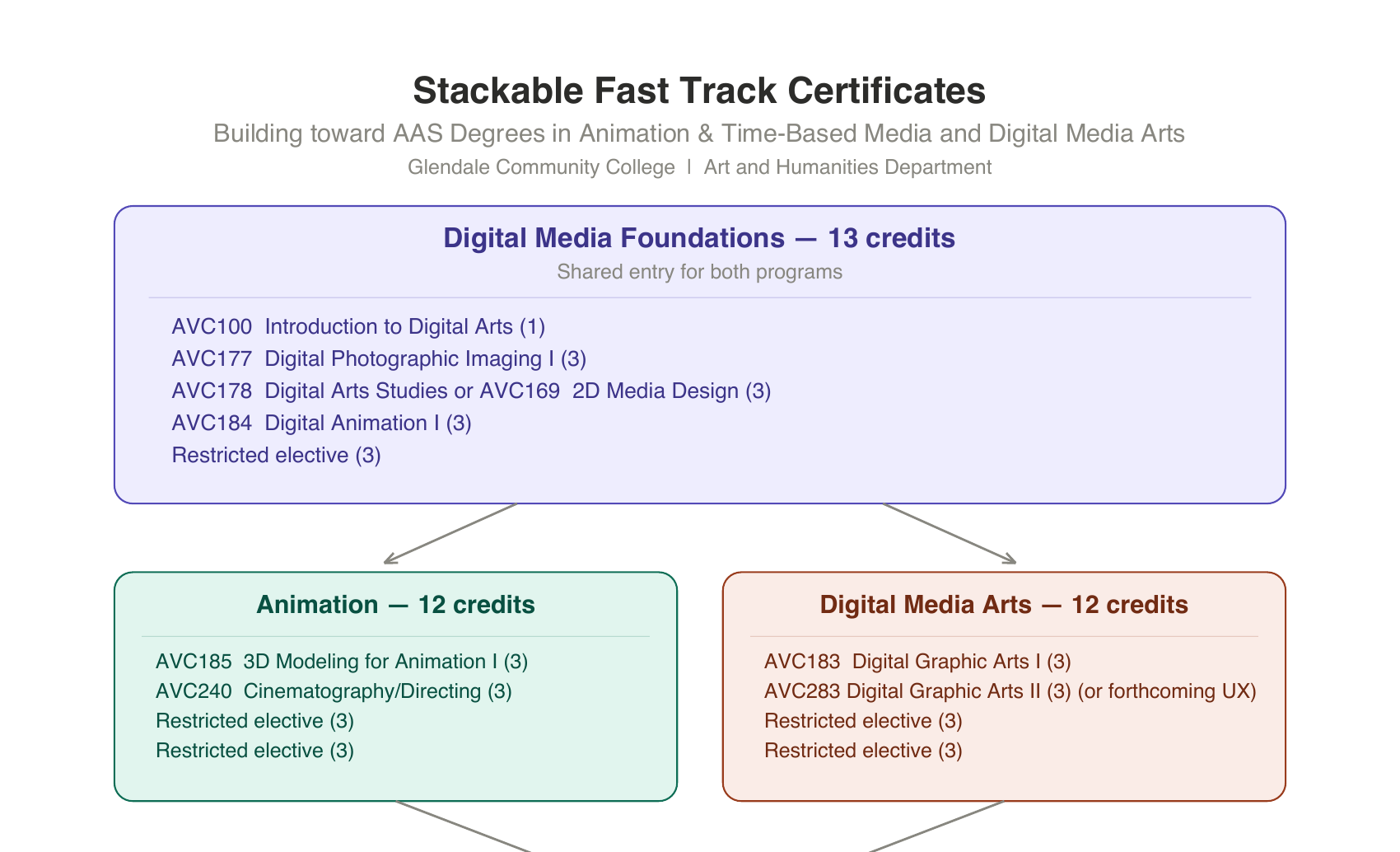
The credentials were mapped to their degree outcomes and then broken into stackable blocks that nest cleanly into the AAS.
Three blocks make the ladder: a shared Digital Media Foundations entry of 13 credits that both programs start from, then a 12-credit track block for either Animation or Digital Media Arts, then a shared Professional Practice and Portfolio capstone of 12 credits. Each block stays under the district’s fifteen-credit fast-track cap, and all three stack to 37 credits that count straight toward the Animation and Time-Based Media AAS or the Digital Media Arts AAS.
Technology
- Built and submitted through the college’s Instructional Council curriculum-approval workflow.
- Maricopa enrollment and completion data.
Outcomes
Approved and going through the curriculum process. The measure is whether more students earn a credential early and persist toward the degree, and whether the on-ramps reach the students they are built for. Those numbers come once the microcredentials are running; for now the outcome is named rather than claimed.