The Traveler
Design · Case study
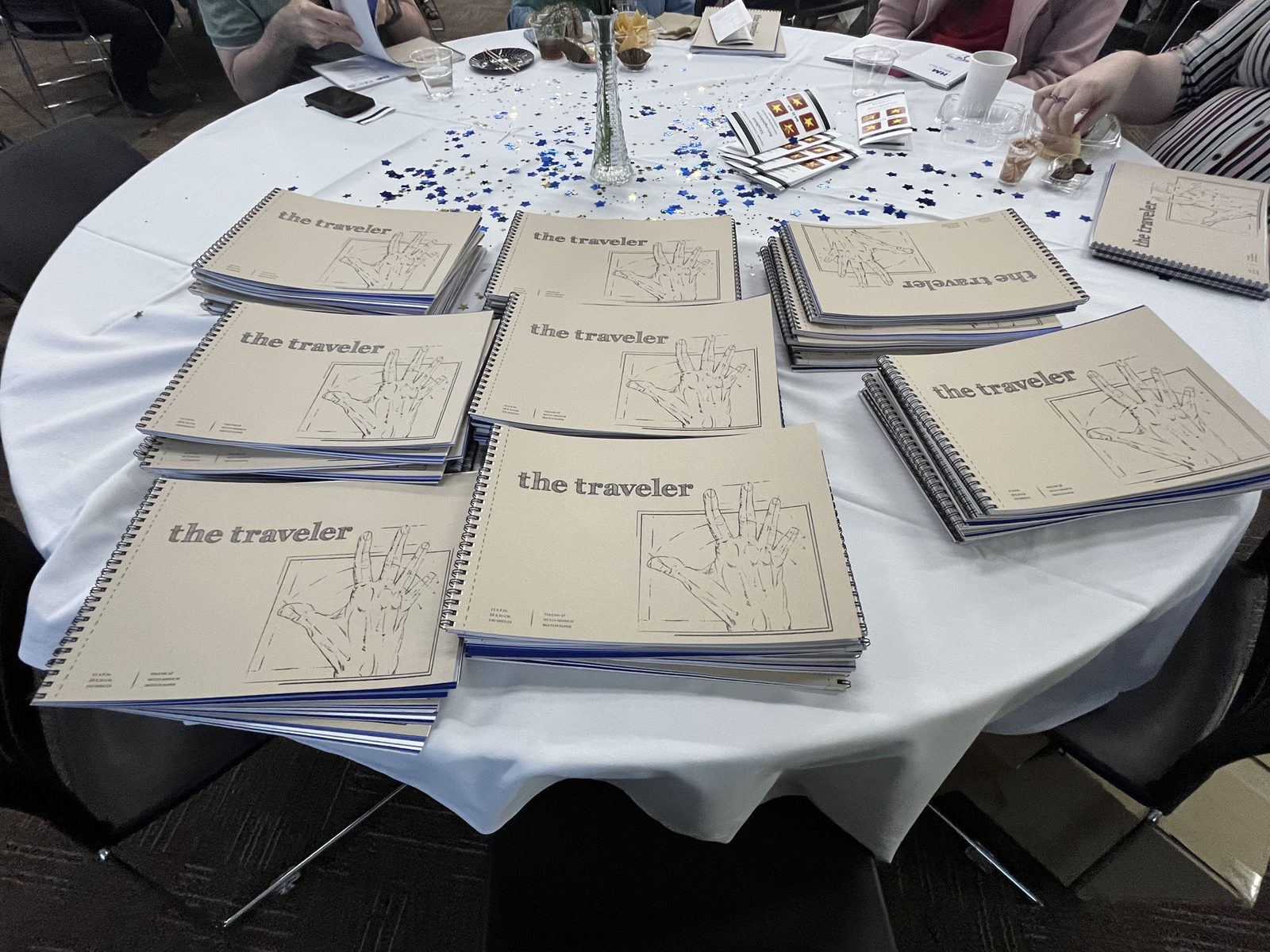
Glendale Community College’s award-winning student literary and arts magazine, designed end to end by students. Fifteen editions over sixteen years, Volumes 44 to 58, each with its own concept, and early ideas for the next edition are taking shape.
Goal
Give students authentic, end-to-end publishing experience: a real production cycle with real deadlines, a real client, and a finished printed piece for their portfolio. The magazine is the curriculum.
Audience
| Audience | What the magazine does for them |
|---|---|
| Student designers | A full production cycle, from concept to press, that becomes a portfolio piece and often a first credit on a résumé |
| Student writers and artists | Publication of their work in a juried, printed magazine |
| The campus community | A yearly record of the college’s creative work, presented to the college president |
| The public record | Back issues live in the GCC library archive and the Arizona state library’s Arizona Memory Project |
Process
The Traveler runs as a long apprenticeship. Every year a new student team takes the magazine through a full production cycle, and my role as faculty advisor is to mentor them through it: modeling the professional process, coaching through critique, and holding the deadlines. The team does the work itself, from concept to the printer’s proof.
The content comes from a competition: students submit literary and visual art, student judges make the first cut, and one community judge selects the winners. The design team sets the theme and produces the book, and photography student workers photograph the artwork for print.
Every edition has a concept
No two editions look alike. Each team starts by choosing a theme that drives the whole design system. For the 60th anniversary edition, each chapter became a decade of the college’s history, set in that decade’s design language, with a running timeline across the covers, a three-column grid and body type held constant throughout, and the college red carried through every decade’s palette. Each decade was assigned to its own student designer. Every cover and theme is on the Editions tab.
Technology
- Adobe InDesign for layout and typesetting, Photoshop for preparing art and photography, and Illustrator for icon libraries.
- Miro for concept boards, assignments, and the production timeline.
- Early ideas for the next edition, including augmented reality, are on the Next edition tab.
Outcomes
Fifteen editions, each taken to press by a new cohort. The magazine has won College Media Association Pinnacle Awards, a national competition, for its 2015, 2025 and 2026 editions, and has been a repeat selection in the AIGA Best of Phoenix Design Show. Students who led the design team have gone on to design jobs, and every edition reaches a real audience and becomes part of the college’s permanent record.
| Edition | Pinnacle Awards, Two-Year College division |
|---|---|
| 2015 edition | Literary Arts Magazine |
| 2025 edition, the 60th anniversary | Three awards, including College Literary Magazine |
| 2026 edition | Two awards: Cover Design and Literary Arts Magazine |