How Many Segments, Really?
Course Design · Case study
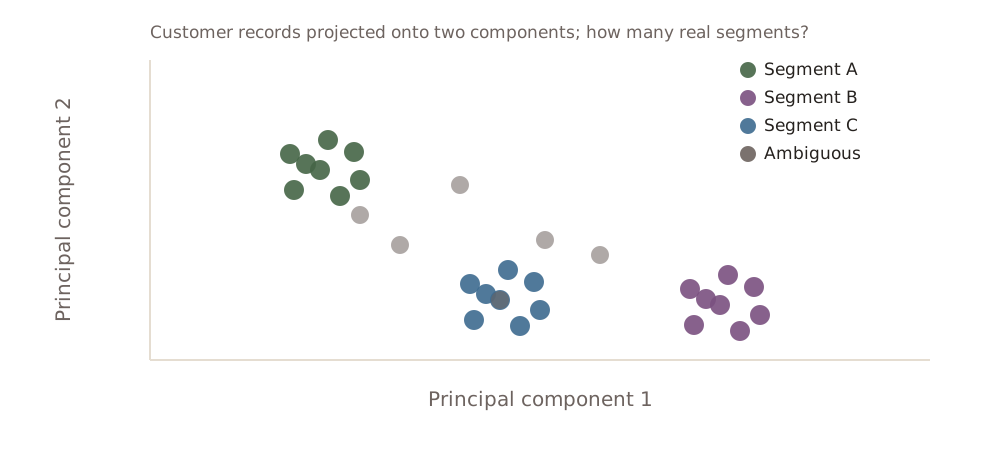
Marketing wants a fixed number of customer segments, and a colleague insists it is five. Your job is to defend the count the evidence actually supports, not the one that is convenient.
Run the simulation
What this simulation is
This is the summative simulation for the clustering and PCA module. The learner is handed a customer dataset with genuine underlying structure, correlated noise columns, and non-spherical, unequally sized groups that punish naive k-means. The work is judged the way segmentation is really defended in industry: on cluster stability under bootstrap resampling, on agreement with the instructor’s private ground-truth labels the student never sees, and on the rigor of the cluster-count argument.
A confident answer with a weak justification scores worse than a cautious answer with strong evidence.
What it assesses
- Standardizing features so no single column dominates the distance metric.
- Justifying PCA for decorrelation and dimensionality reduction, not as a scaling fix.
- Running more than one clustering method so the conclusion is not method-dependent.
- Reading internal indices (silhouette, gap statistic, within-cluster sum of squares) across a range of k.
- Assessing stability with bootstrap resampling and reporting co-clustering consistency.
- Defending a cluster count with converging evidence rather than a single elbow plot.
- Profiling each segment in plain language a marketer can act on.
The instructor’s private ground-truth labels and the injected structure of this dataset exist nowhere online, so a pasted generic answer cannot match them. Because the count must be defended under bootstrap stability tied to this exact data, a plausible-sounding but unverified number scores poorly.