Wayfinder
Personal Projects · Case study
A 15-day road trip with my son, planned with AI in a few hours around three nights at Yosemite. Along the way it grew a campground finder.
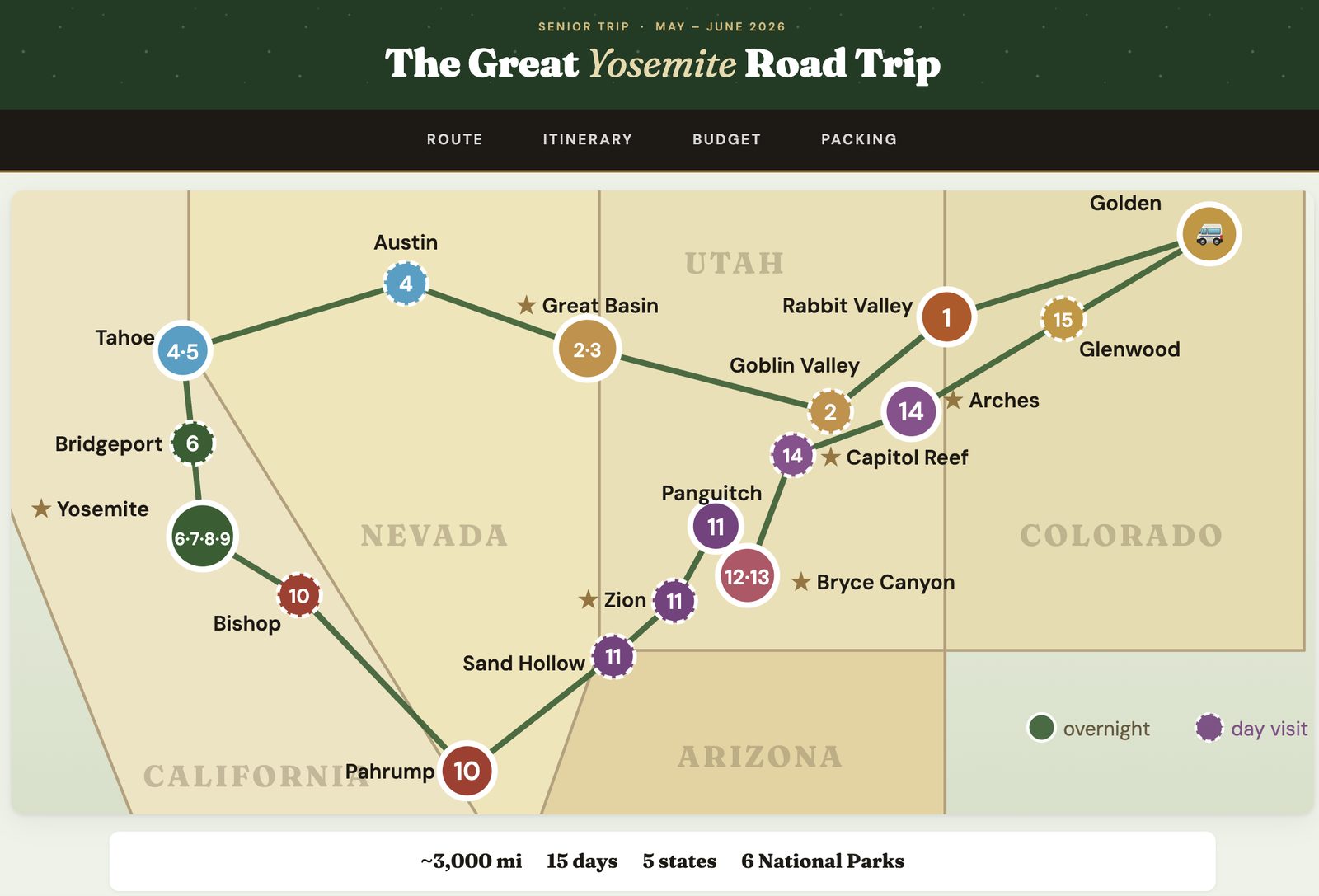
Goal
My son had just graduated from high school, and he found three open nights at Yosemite. The goal was to build a whole road trip around those three nights, in the few hours we had to plan it, and to make it the trip the two of us wanted.
People say AI is not about people. This was fifteen days on the road with my son, and AI is the reason we got to take it.
Audience
The two of us first. Then anyone planning a long drive: once the page worked for our trip, I added a builder so the same structure can be made for someone else’s.
Process
Wayfinder was never designed up front. It started as one request and I kept adding to it, before the trip and on the road. Each thing we cared about became part of the page.
- Three nights at Yosemite. The fixed point. Every other day was planned backward and forward from those dates.
- Lake Tahoe, on the water. Our second most important request. We asked for the best campgrounds close to the lake, lakeside if possible. The good campgrounds are booked eleven months out and every lakeside site was taken, so AI went looking for cancellations. Three days before departure we had beach sites at D.L. Bliss State Park. That search became the Campground Finder, a watcher that writes each opening to a calendar, where the trip is being planned anyway. It later ran daily against Peak One Campground at Dillon Reservoir.
- Hot springs and bouldering. We asked for every hot spring and bouldering spot along the route that was not too far out of the way.
- Climb or hike every day. Each day has one or the other.
- Rest days. We did not want to drive every day, so the route has days that stay put.
- Geology along the way. Notes for each leg, so we knew what we were driving through and what we were driving toward.
- Weather and fire bans. Live weather for each stop and the fire restrictions for each camp, added as the dates got closer.
- More days. The plan kept growing as we found things worth stopping for. It ended at fifteen days, about 3,000 miles, five states and six national parks.
Technology
- A self-contained HTML planner plus a static builder page: vanilla JavaScript, no backend.
- An inline SVG route map, no tile server and no map token, so it renders offline.
- Keyless Open·Meteo weather, fetched live in the browser.
- localStorage for the packing list, so what is packed stays checked.
- A scheduled agent for the campground cancellation watcher.
- Hosted on GitHub Pages.
Outcomes
Finished and in personal use. We took the trip, and the planner and the builder are live. The Campground Finder went from a written specification to a working build, which is what Render asks of a student; its watcher is switched off between trips. There is no account and no server: trip and packing details stay in the browser on the traveler’s own device.