Syllabus Checker
Course Design · Case study
Submit a syllabus. It checks the required district language and the seat-hour statements, names exactly what is missing, and shows the department who has complied.
Goal
Every term, each syllabus is reviewed by hand against the MCCCD required elements, program-specific additions, and approved institutional language that must appear verbatim rather than paraphrased. The review is slow, its consistency depends on who performs it, and the feedback loop is long enough that an instructor may learn in week six that a required statement was absent in week one. Meanwhile the department has no consolidated view of who has complied.
Audience
Two distinct users with distinct needs. The instructor must act, and therefore requires specific, actionable feedback. The department must monitor, and therefore requires an aggregate view. Conflating these is the design error most compliance systems make.
Process
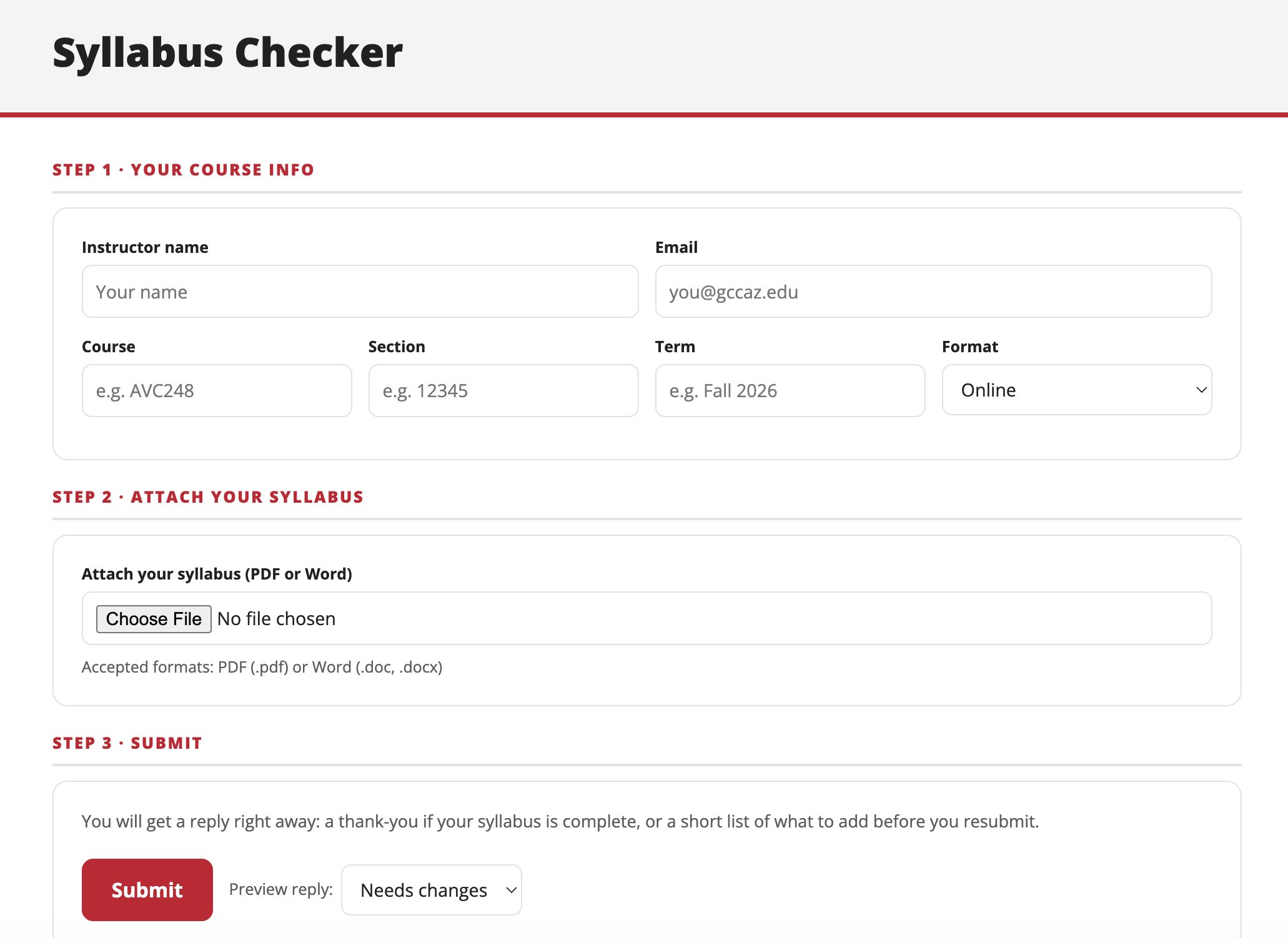
Faculty submit through the department’s existing Google Form, preserving established practice. Submission triggers a review against the MCCCD Regulation 3.6 required elements, program additions, and the approved seat-hour and Regular and Substantive Interaction language. The instructor receives a response within seconds: confirmation of completeness, or an itemized account of what is absent, with the correct approved wording supplied inline so that no further search is required.
The result is simultaneously written back into the form’s existing response spreadsheet as status columns, giving the department a single sortable view of compliance across all sections without generating an inbox of individual reports.
The system is read-only. It reports, it never revises. No instructor should discover that an automated process has silently altered a document they are accountable for.
Technology
- Built on the department’s existing Google Form and its response spreadsheet with Google Apps Script, so there is nothing new to learn and nothing leaves the district’s Google environment.
- A syllabus contains no student data, so none is involved at any stage.
Outcomes
In use in the Art and Humanities department. Success was defined before launch: a syllabus reviewed in seconds instead of by hand, an instructor told exactly what is missing, and a department that sees compliance across all sections at a glance instead of chasing individual reports.