AVC 248, an AI-powered capstone
Case study · Learning Design
An end-to-end online course designed and built in Canvas: nine scaffolded modules that take design students from AI literacy to a finished portfolio, a career plan, and their own portable AI career agent.
Provenance. Designed and built by hand by Michelle Blomberg, the subject-matter expert, informed by the program’s industry advisory board. It stands on its own; I ran it through my skill afterward only to check alignment and accessibility (AI-assisted course design).
Goal
Turn the professional-practices capstone into an online course where every student leaves with something they keep using: a real portfolio, a career plan tied to the jobs they actually want, and a working understanding of how to build with AI. Not a grade, a launch. The whole course is designed backward from measurable competencies, with a competency map tying every module to the program outcome it serves, so the finished experience holds together end to end.
Audience
Online design students finishing an associate degree, most of them working adults, each headed toward a different goal. The course also doubles as a model other faculty can borrow for building an AI-literate course of their own.
Process
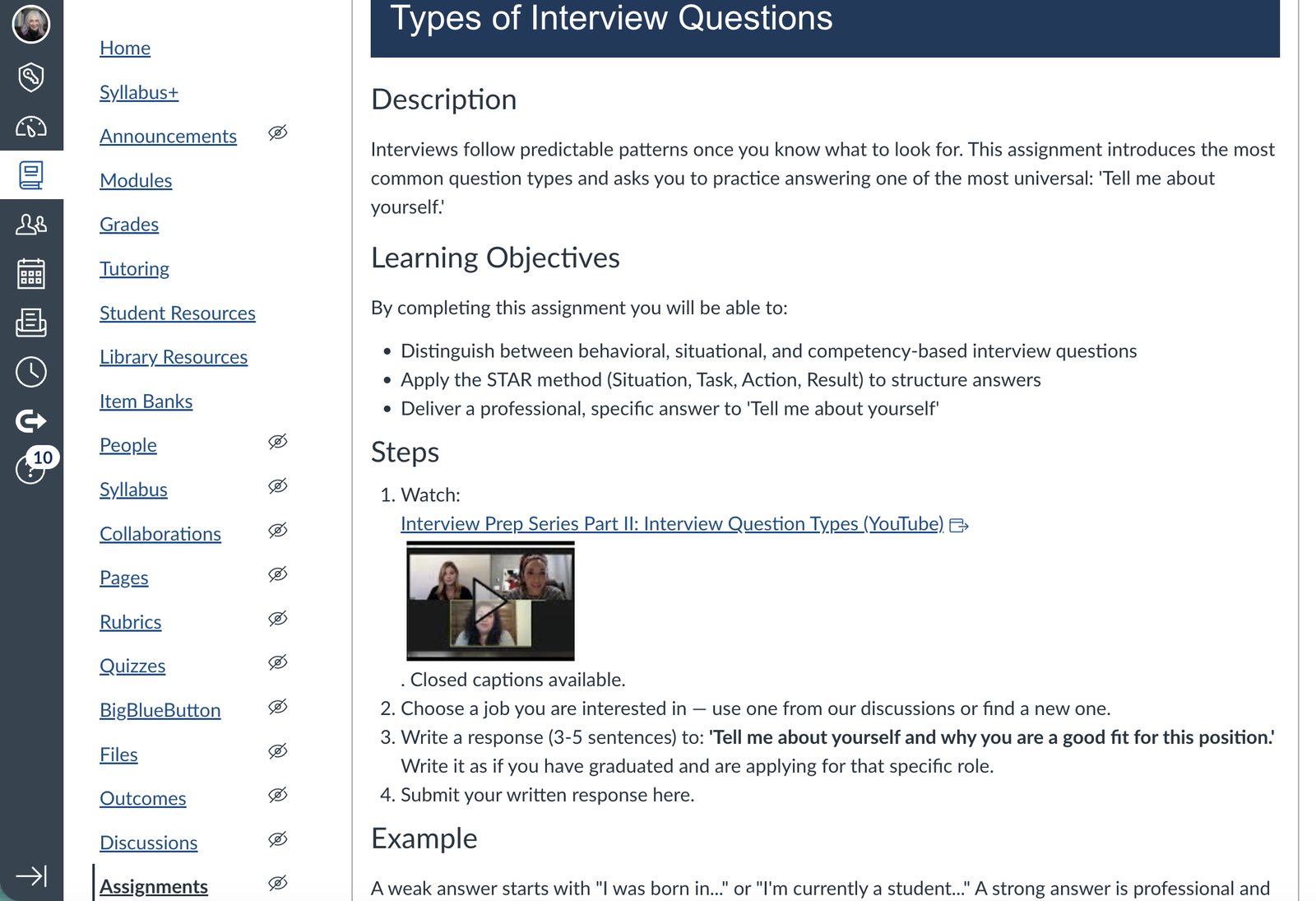
The course is designed backward from measurable outcomes, built on a competency map, and authored directly in Canvas, packaged so it can be imported cleanly. An AI-literacy unit opens the term so students understand the tools before they use them. From there they work through nine scaffolded modules, each a step built on the last toward the finished portfolio, using Render, the career tool built into the course, across the entire semester rather than as a one-off assignment. Universal Design for Learning runs through every module: the competency stays fixed while the way a student demonstrates it flexes, a written rationale or a recorded walkthrough, so the same outcome is reachable more than one way.
Technology
- Learning-science foundation: backward design from measurable competencies, constructive alignment of every outcome to a real artifact and a spoken walkthrough, Universal Design for Learning, and WCAG 2.1 AA accessibility built in from the first draft.
- Canvas as the LMS, authored directly in it and packaged as IMSCC for clean import.
- Instructional video recorded and captioned in Canvas Studio, so every video is accessibility-checked.
- Competency rubrics for assessment, with Canvas analytics, project-rubric results, and outcome-mapped Google Forms surveys (built with Google Apps Script) driving the term-over-term revision.
- Render, the career tool built into the course: a hand-built single-file HTML, CSS, and JavaScript app on a provider-agnostic AI layer (built on Claude and the Sonnet API, portable to Gemini or any sanctioned model), so it runs on whatever an institution already trusts.
- Student-facing tools: Adobe Creative Cloud (Illustrator, Photoshop, After Effects) for the portfolio and media work.
- Discord for critique and community, Miro for planning.
Outcomes
Every outcome is evidenced by a real artifact and a spoken project walkthrough, so the proof is the student’s own performance, not an exam a model could sit. The course produces three durable results a student carries out the door: a finished portfolio, a career plan tied to the jobs they actually want, and their own portable AI career agent.
The design is read in Canvas analytics and revised every term. One result of that iteration: the mock interview was rebuilt from a single high-stakes task into distributed practice across the semester, so students rehearse repeatedly rather than once.
Status
The full AI and assessment structure runs for the first time in Fall 2026, with Render entering its first pilot that term. The design is built and ready, and the fall run is where its effects get measured.