Michelle Blomberg

CopaMigo

Case study · AI Tools & Strategy

A multilingual AI triage tool that answers in the student’s own language and routes their plain-language problem to the right human service with a warm handoff card.
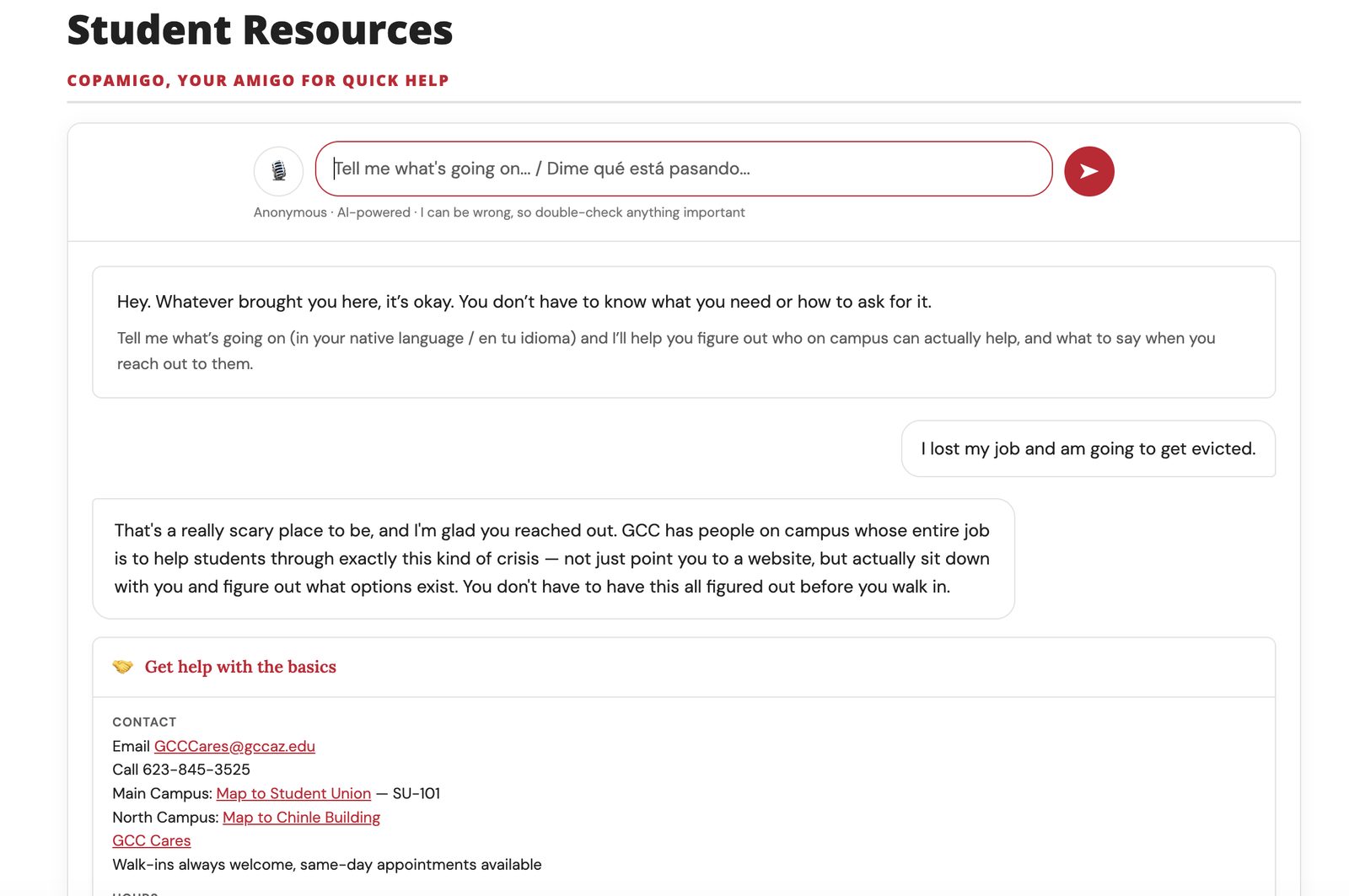
CopaMigo student connection tool interface

Goal

Get a stuck student to the right person quickly, without making them name the office or know the vocabulary, at the moment that often decides whether they stay enrolled. Every successful handoff is a small persistence intervention.

Every campus already offers more support than its students can find. The services exist; students just do not know which office handles their problem, or what it is even called, and the ones who most need help are often the least likely to walk in and ask. CopaMigo is a stigma-aware triage tool that closes that gap. A student describes their situation in plain language, in the language they think in, English, Spanish, or any language they write in, and it routes them to the right service, such as financial aid, food, child care, or counseling, with a warm handoff card showing the contact, hours, and what to ask for. It is anonymous, with no login. What sets it apart from the chat widget on most college homepages, which only scans the website and hands back links, is that CopaMigo’s answers are written rather than retrieved, drawn from the questions students actually bring me and shaped in consultation with the offices that handle them, so a student gets much closer to what that office would tell them in person.

The gap I was designing against

Most colleges, mine included, already run an assistant on the website. It answers from what the site says, which means it can only be as good as the site is organized, and a college website is organized around departments rather than around what a student is trying to do. Ask it a question in the words a student actually uses and it hands back links. That is not a defect in the tool. It is the ceiling on any assistant that retrieves from a sprawling site it did not write.

The questions students actually ask are mostly not on the website. They are the ones I have been answering in person for twenty-five years. What happens to my aid if I drop this class. Who do I talk to if I cannot pay this week. Is there food. Can I bring my kid. Am I going to get in trouble for asking. Those answers live in the heads of the staff who do the work, not on a page a crawler can index, and a student in that moment does not want a link. They want to know what the office will say when they walk in.

Landscape scan

Before building anything I checked whether this already existed. Student-success platforms cover a good deal of this territory, EAB Navigate360 most directly, alongside case-management and campus-chatbot products from Ivy by Gravyty, Civitas Learning, and others. They are strong where they are meant to be strong: case management, early alerts, scheduling, campaign outreach, and in several cases routing. The piece I could not find anywhere was the one CopaMigo is built around, a curated answer bank written for the way students actually ask rather than retrieved from a website, and designed so the office that owns each service owns the wording of its own answers. That is the difference between sending a student to the financial aid page and telling them what the financial aid office would actually tell them.

This overlaps the problem space of a student-success platform without being one. CopaMigo is the front door and the content layer, not the case-management system behind it, and it was always designed to hand its content to whatever platform a college ends up running.

Audience

Students hitting life or academic barriers, especially first-generation and Spanish-speaking students, who are not sure where to go. The research is consistent: when students feel connected to their college and its services, they stay enrolled at higher rates. CopaMigo meets them in their own words first, and names the office only after it has met them with empathy.

Process

A student types or speaks their situation and CopaMigo reads it for urgency and need, then either answers directly from the curated answer bank or points them to the right office with a warm handoff card. A live, in-tool connection to a staff member is a planned next feature. It is anonymous by design, no login and no student record. The full routing model, crisis handling, accessibility, and rollout plan live in the PRD.

The content is the product. Every question CopaMigo answers was hand-picked and hand-written, drawn from twenty-five years of the questions students bring me and developed in consultation with the offices that handle each service. Nothing is scraped and nothing is inferred. That is also the honest limit of where it stands today. The answers are mine, informed by those conversations, and they have not yet been formally verified office by office.

Technology

Outcomes

CopaMigo was tested with students, and the routing and the answer bank were revised from what those sessions surfaced. No outcome numbers are claimed yet; the Fall pilot is where those get measured. Success is defined up front, the marks of a working service-design intervention: whether a student reaches the right office faster and with less friction than searching the college website, whether the questions students actually ask line up with the answers each office verifies, and where answers are missing so the office that owns the service can write them. The pilot inside the Canvas Student Resources button is the mechanism, real questions from real students, checked against what each department will have confirmed through the intake form.

The answers are written, not scraped, and the verification step is the one that has not happened yet. The content came from the questions students actually bring me, developed in consultation with the offices that handle them, so it is informed by those offices rather than signed off by them. The next step is built and not yet run: the CopaMigo Question Intake form lets each department review what is loaded under its name, correct what is wrong, and add what is missing with the real answer attached. Getting every department through that form is what turns each routed answer into one a named advisor stands behind, and I would treat it as a prerequisite for production rather than a refinement. The staff-facing half of the tool is on the Staff knowledge builder tab.

Status

CopaMigo is sunsetting as a standalone tool, and for students that is a good outcome. The goal was always to get a stuck student to the right office faster, not to be the product that does it. A campus student-service office has adopted Ivy by Gravyty, an established higher-ed AI assistant, and CopaMigo’s work feeds straight into it. The curated questions and answers, the plain-language triage and routing, and the more than one hundred verified service links become the starting knowledge programmed into Ivy for the Fall 2026 pilot, with department-by-department verification to follow there. That is what running a pilot is for: some go to production, some hand off what they proved and sunset. What matters is that the people who can put a tool like this in front of every student now have the research to do it well, and students find help either way. Everything learned here becomes the foundation of the next build.