Design history, taught by students
Course Design · Case study
A team project in Digital Graphic Arts 1. Each pair becomes the class authority on a period of design history and teaches it back, in a presentation designed in the visual language of the era. The survey exists only if the teaching works.
Goal
Design history is conventionally delivered by lecture and assessed by recall, a pairing that produces students who can name the Bauhaus and cannot recognize its influence in front of them. This project inverts the arrangement, so the history is learned by being reconstructed rather than received. A viewer should be able to name the decade before reading a word, which converts a research assignment into a design assignment: the student cannot satisfy the criterion without having internalized the period’s typographic conventions, palette, compositional logic, and ornament.
Audience
Students in AVC 183, Digital Graphic Arts 1. First-semester design students, learning the software and already accountable for judgment: what a period looked like, why it looked that way, and what it argued for.
Process
Six teams, two students each, dividing 1895 to 1989 into consecutive spans. The periods are assigned with a research hint rather than a reading list, since the object is to teach the student to find the material, not to find it for them.
| Period | The hint they are given |
|---|---|
| 1895 to 1919 | Look at what was happening in Vienna and Glasgow, not just Paris. |
| 1919 to 1933 | There was a school that changed everything. Also look at Russia at the same time. |
| 1933 to 1945 | Follow where the designers went when political regimes forced them to leave Europe. |
| 1945 to 1960 | Look at American corporate culture and what was happening in Switzerland. |
| 1960 to 1976 | Do not focus only on the US. Look at protest movements on both sides of the Atlantic. Japan is worth a look. |
| 1976 to 1989 | Music culture drove much of the design of this era. Also look at what the personal computer started to change. |
Each hint names an omission rather than a fact, so the first thing a student learns about their period is that the canonical account of it is incomplete.
The instructional move is peer teaching: a student who expects to explain rather than be tested organizes for coherence (the protégé effect), and a classmate who has just understood something is often a better guide than an expert (Vygotsky’s zone of proximal development). No team is given the whole survey; each is given a sixth of it and made responsible for the rest of the class receiving that sixth.
The project runs in three graded phases, so that research, design, and delivery are assessed as distinct competencies.
Research. At least two pages of notes in a shared team document, with every source linked as it is gathered. The assignment names the library and the archives (Wikimedia Commons, the RISD Picture Collection, the Met Open Access Collection, the Library of Congress), and says that faculty librarians are among the most underused resources on any campus.
Design. Students write a product requirements document before they open the model: what it does, who it is for, what the sections are, what it should look like. Then they build with AI in the form they choose (a Gemini Gem, a Gemini Notebook, or an interactive slideshow, sorting game, timeline or quiz built by directing a model), with one prohibition: no default templates. The PRD is the assignment; the tool is the by-product. This build began as extra credit and is now how every student designs the project.
Presentation. Recorded, published unlisted to the student’s own YouTube channel, and posted for the class. Students comment on every classmate’s presentation, not a selection.
On AI, the assignment teaches the method (role, task, format; then deep-research modes; then verification), notes which models are free through the district, and states plainly that models hallucinate designer names, dates, and publication titles. The historical images must be real. AI-generated decoration is acceptable; an AI-generated poster is not. The evidence of learning is in the sourcing, the design judgment, and the live defense, none of which a model can supply.
Technology
- AI tools (Claude, Gemini, Copilot, ChatGPT) for research and for design, with verification required.
- Delivered in Canvas, with instructor video recorded and captioned in Canvas Studio so every video is accessibility-checked.
- Students collaborate on the content in Google Drive, sharing and co-editing their research and materials as they build the project together.
- Presentations are recorded with OBS, the departmental standard, and shared for peer critique on Discord.
Outcomes
In active use, taught each term on the student-as-teacher model; the student work shown below is from real sections. By the end of the project a student will be able to:
- Research a design-history period using academic databases, library collections, and primary archives, and evaluate the credibility of each source.
- Organize a body of historical research into four to six defensible categories, whether movements, designers, themes, or spans within the era.
- Produce a designed presentation whose typography, color, layout, and imagery reproduce the visual conventions of the period.
- Cite every image and source completely, including the artist, title, date, and provenance, and disclose the use of AI tools.
- Teach the period to peers in a recorded presentation, and respond substantively to every classmate’s work.
The project carries the college’s Visual Communication institutional learning outcome for analysis, critique and interpretation, which asks that a student interpret visual work and account for the choices behind it. The outcome attaches to the presentation rubric.
Students who have only ever used a model conversationally discover that specification precedes generation, and that the quality of the output is bounded by the clarity of the intent. It is the single most transferable thing in the project.
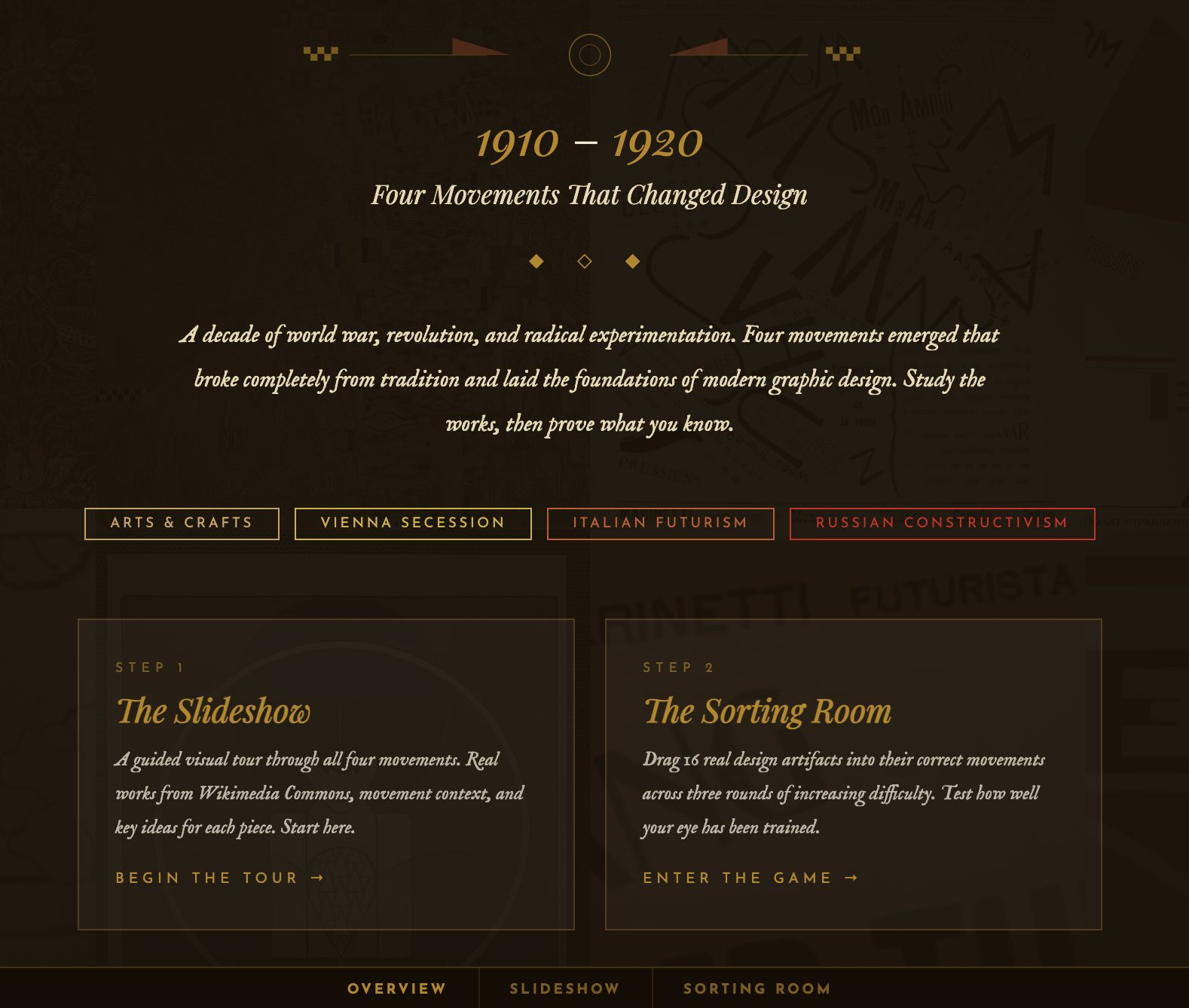
The class example is a 1910 to 1920 slideshow with a drag-and-drop sorting game, built to demonstrate the standard rather than to be copied.