Student Journey Barriers Study
AI Strategy · Adoption · Case study
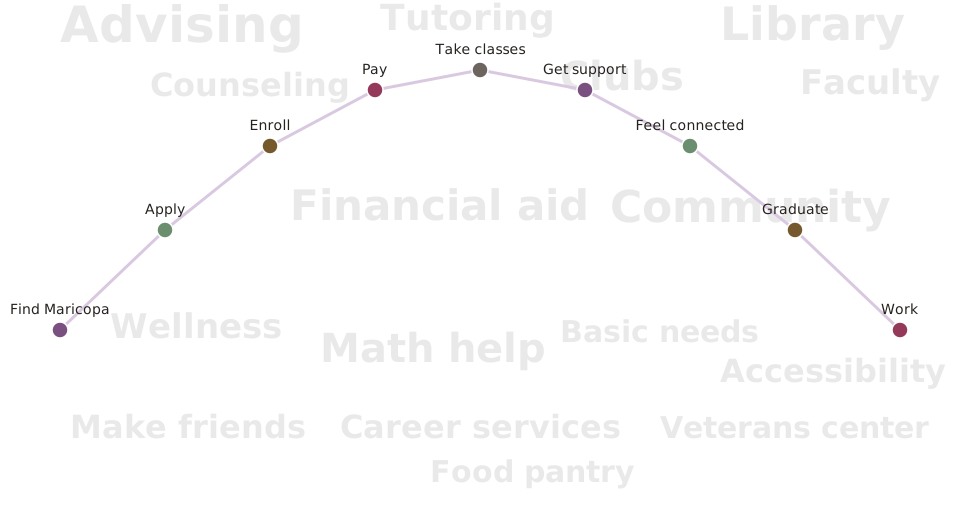
A ten-college study of the district student journey, from finding a college through to work, mapping where students hit barriers reaching support. I designed the study and I lead it as co-chair of the Student Support and Success domain, working with advisors, financial aid specialists, and student-facing staff across the district.
Goal
Set a baseline of how many students use each service now, then find and rank where students hit barriers reaching support by how many students each gap touches, and hand staff located, severity-rated evidence they can act on.
Audience
The Student Support and Success domain of the district AI Resource Center, made up of advisors, financial-aid, and other support staff across all ten colleges, plus the college leaders and faculty who help run the study and recruit the student build teams.
Process
Build fifty demographic-grounded personas as specialist agents and walk each service at each of the ten colleges. Log what breaks and how badly with more than one rater, rank the highest-reach gaps, decide where AI fits first, recommend and pilot the most promising fixes to prove they help before anything scales, then have student teams build them as human-in-the-loop tools. Humans decide what to fix. No one is replaced.
The walk runs in three parts by access.
| Phase | What it covers | Where it stands |
|---|---|---|
| Phase 1 | Public tasks that need no login. | Run twice. A third round is planned. |
| Phase 2 | Signed-in tasks, on one sanctioned test account. | Not started. Waits on district approval and the data-governance review. |
| Phase 3 | Tasks that depend on the district’s incoming Salesforce platform. | Not started. Waits on that platform. |
Technology
| Piece | How it works |
|---|---|
| The agents | A multi-agent system: fifty synthetic students, one orchestrator and one research aggregator. Each synthetic student walks a college’s live site the way that student would, narrates what it is looking for, and returns a finding. |
| Structured output | Every run returns its finding in a fixed JSON schema: the barrier, its location, the path taken, the local service name, a severity flag, and the persona and campus that produced it. |
Agents carry breadth; people carry judgment. How the agents work, and the research behind the method.
Outcomes
Phase one is complete: the public student journey has been tested across all ten colleges. The next phase, inside the systems students use after they log in, begins once the domain’s two executive sponsors, a college president and the district’s vice chancellor and chief information officer, have briefed student services leaders at each college. Findings stay unpublished until the domain confirms them.
The study produces a prioritized, severity-rated map of where students hit barriers, alongside a service crosswalk across all ten colleges and a human-in-the-loop AI roadmap routed to the right owners.