Michelle Blomberg

Rough Cut

Case study · Teaching/Program Design

Recruitment outreach for all four digital media programs, designed end to end with AI and aimed by AI research at the specific teachers and advisors who already have our future students in their classrooms.
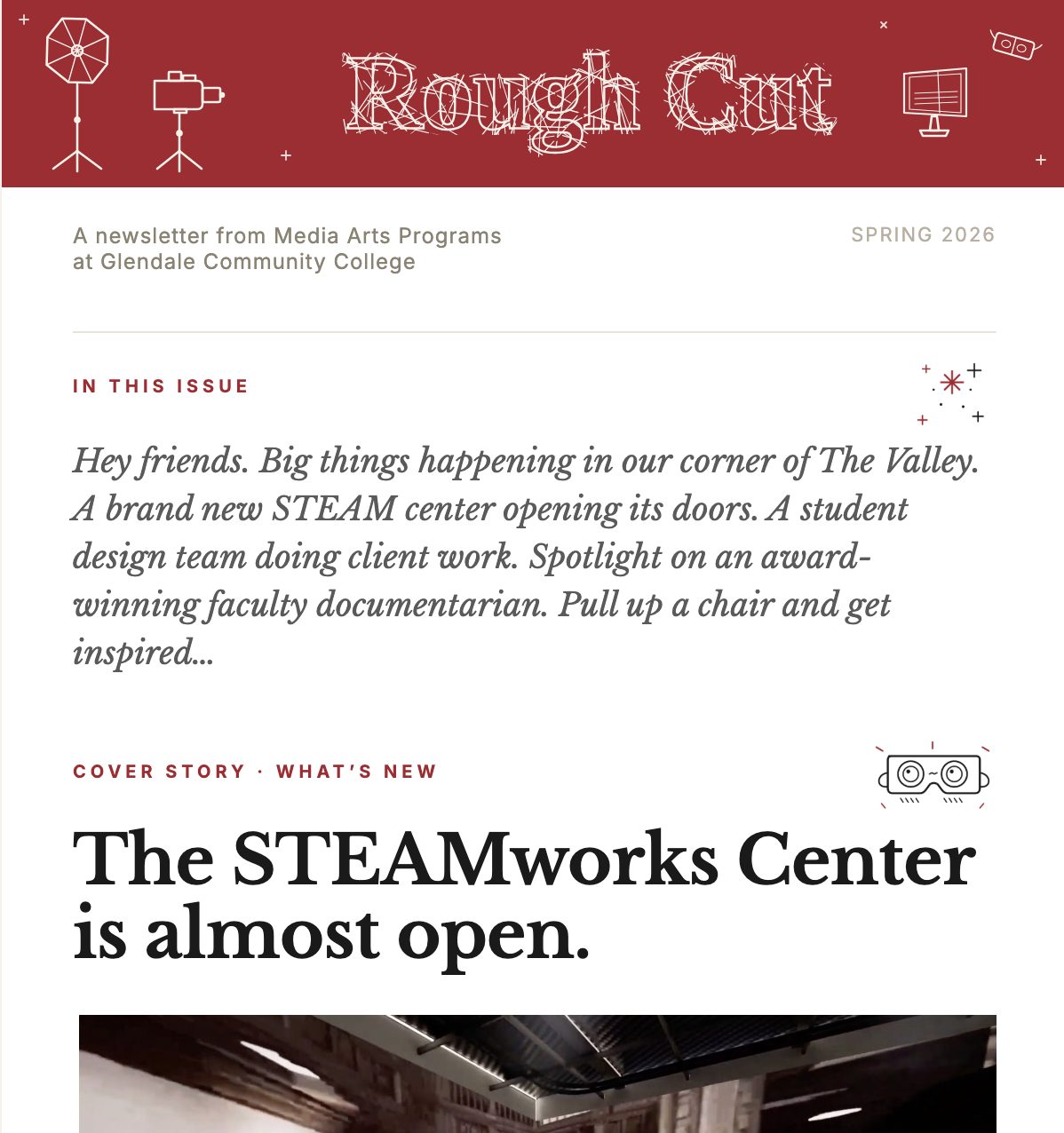
Rough Cut newsletter cover

Goal

Reach future students before for-profit and private colleges lock them in. Those colleges recruit early, so the newsletter and its contact list exist to put a public option in front of students and counselors first. It is part of the program’s recruitment and pipeline work.

Rough Cut is an outreach newsletter for the four digital media programs at a community college, Animation, Digital Media Arts, Film and Media, and Photography, sent to regional feeder high schools. Each issue carries program updates, student award winners, faculty and alumni spotlights, and reasons to come visit.

Audience

Regional high school students, and the specific adults who already have those students in front of them. Not the front office. The list targets CTE instructors and advisors, art teachers, photography teachers, audio and video instructors, yearbook advisors, gaming clubs, and anyone else whose room is full of students who would recognize themselves in these programs. A counselor forwards a newsletter. A yearbook advisor hands it to the kid who shoots every football game.

Process

Designing it with AI was the point. Drawing it by hand would have been faster, and that is the finding, not an apology. The whole thing was built with AI on purpose, to learn from experience rather than opinion how far a model can actually be pushed on a real design problem with a real deadline. The format, the header, the icons, the whole visual system came out of that process, none of it drawn by hand. It was harder than doing it manually. Directing a model to a specific visual outcome is its own skill, and it costs more than people who have not tried it think.

The harder half was the targeting, and it is the part that took real effort. Working with AI, the process worked through every high school in our priority zone one at a time, digging through school sites, staff directories, program pages, and club listings to surface named, relevant people rather than a generic address. That is a slow, messy research problem: every school publishes differently, half the useful pages are buried, and the person who matters is rarely the one listed first. The result is a contact list built around who actually teaches our future students, and it is the engine the newsletter runs on.

The newsletter is the recurring touchpoint that list carries, twice a year, backed by a visit form for schools and students who want to come see the studios in person.

The heart of Rough Cut is the contact list behind it: more than 200 named people across three dozen regional high schools, the art and media teachers, photo and audio/video instructors, yearbook advisors, club sponsors, CTE coordinators, and counselors who actually talk to students about where to go next. We did not have deep ties to most of these schools, so this list is the starting point, the foundation we are building those relationships from. It is a living document, not a finished one. It grows and gets corrected every time we reach a school, and each issue of the newsletter is a reason to add the next name.

Technology

Outcomes

Two things already stand as outcomes. The first is the asset itself: a living, named contact list of more than 200 relevant instructors, advisors, and counselors across three dozen regional feeder high schools, plus a full recruitment visual system and a working visit-form pipeline, the pieces the pipeline runs on rather than a one-time campaign. The measure going forward is relational, whether the newsletter puts the public programs in front of students before for-profit and private colleges lock them in, and whether the school-by-school outreach turns cold lists into real relationships, so those are named up front rather than claimed while the cadence is still young. The second is a methods finding worth keeping: directing a model to a specific visual outcome, and running the targeting research at this depth, cost more effort than hand work would have, and that trade-off is the point of building it this way, evidence over opinion on where AI actually earns its place in a real design-and-recruitment workflow.

Status

Built and ready. The visual system and the contact list are in place, and the list grows and is corrected school by school. Distribution is paused pending administrative sign-off; in the meantime I am evaluating a dedicated mailing platform so it can run off a shared program account rather than a personal one. It collects no student data.