Light and Lasers: a hybrid photonics course
Course Design · Case study
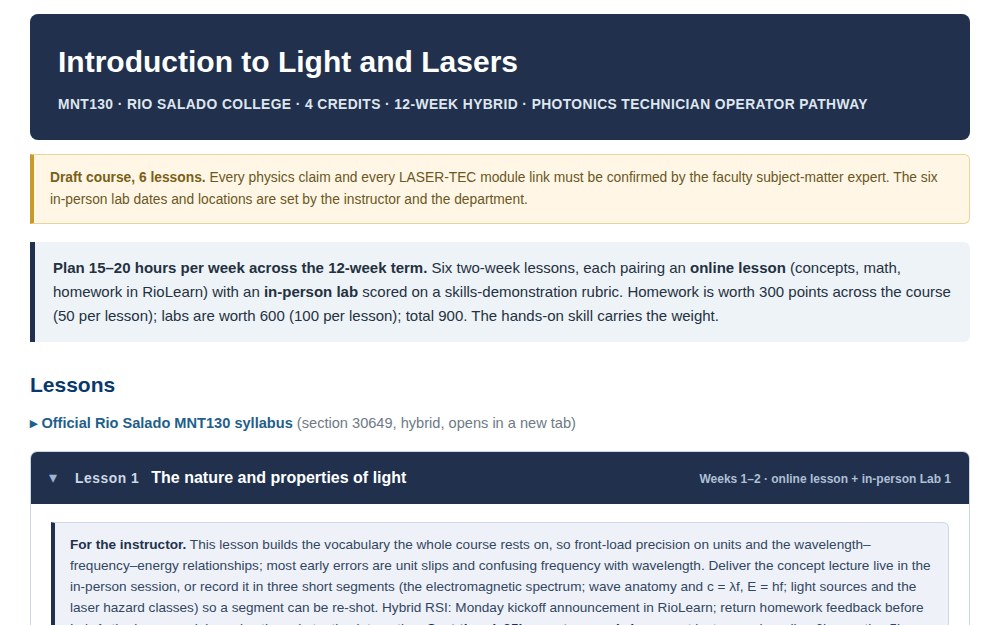
A hybrid photonics course for Rio Salado College, on the Photonics Technician Operator pathway. The online lessons teach the physics, the math, and laser safety; six required in-person labs are where each hands-on skill is demonstrated and signed off, with safety as a hard gate.
Built with an AI method: a panel of expert agents drafts and a human owns the result, run here as a research test in photonics, a field outside my own, with an industry faculty expert reviewing the physics.
Goal
MNT130 Introduction to Light and Lasers is a hybrid course built to carry all seven Photonics Technician Operator competencies to the standard the certification requires. Its central design decision is a question about modality: which learning is well served online, and which cannot be. Conceptual and quantitative learning, the behavior of waves and photons, the physics of laser action, geometric and physical optics, and the mathematics of optical density, lives online, where it can be modeled, practiced repeatedly, and graded. Every hands-on competency lives in a required in-person lab assessed on a criterion-referenced skills demonstration, because a psychomotor skill can be explained online but only performed in person. The course is designed backward from the competencies (Wiggins & McTighe), with each one traced to the online practice that builds it and the lab that certifies it (constructive alignment, Biggs).
Audience
Rio Salado workforce learners on the Photonics Technician Operator pathway, most of them working adults in a two-year program rather than degree-seeking undergraduates. The design follows adult-learning principles (Knowles): the work is anchored to the certification and the job it leads to, it treats the learner’s experience and self-direction as assets, and it gives control over pace within a fixed weekly structure. As a portfolio piece, the page is written for learning designers and academic leaders evaluating hybrid, competency-based design. The course has gone to a faculty subject-matter expert, an industry photonics practitioner, who verifies the physics, confirms the resources, customizes it, and owns it before any student sees it.
Process
The hybrid design is built backward from the seven Photonics Technician Operator competencies, keeping conceptual and quantitative learning online and putting every psychomotor skill in a demonstrated lab. A panel of AI agents drafted it against a fixed quality checklist, with an industry faculty expert reviewing the physics.
Outcomes
Every lesson is designed back from observable objectives written at the appropriate cognitive and psychomotor level (the revised Bloom’s taxonomy for the cognitive verbs). Across six lessons the learner will be able to:
- Relate amplitude, wavelength, frequency, period, phase, and propagation, and convert among wavelength, frequency, and photon energy using c = λf and E = hf with correct units.
- Explain stimulated emission, population inversion, gain media, and optical resonators, and the three defining laser properties of coherence, monochromaticity, and directionality.
- Identify optical components and their functions, and handle, mount, clean, and align optics without contaminating surfaces.
- Apply the law of reflection, Snell’s law, total internal reflection, and the thin-lens and lens-maker’s equations to locate and size an image.
- Compute the optical density eyewear requires from a laser’s output and the maximum permissible exposure, and select correct eye protection.
- Analyze interference, diffraction, and polarization, applying the double-slit and diffraction-grating conditions.
Each objective maps to a Photonics Technician Operator competency and feeds the certification.
How success is measured
Success is defined as demonstrated competence, not time in seat. Conceptual and quantitative mastery is assessed online through low-stakes formative practice and a summative homework set for each lesson (50 points each). Every hands-on competency is assessed in person on a point-valued skills demonstration, six labs at 100 points each, 900 points in all, because a technician skill is a psychomotor performance that a written response cannot certify and a generative model cannot fake. Laser safety is a hard gate: the safety demonstration must pass before any other lab score counts, a mastery-learning prerequisite applied to the one competency where the cost of failure is physical rather than academic. The assessment is criterion-referenced and competency-based throughout: the bar is fixed to the certification, not curved to a cohort.
Pacing and interaction
Every lesson follows the same sequence, so cognitive load stays on the physics rather than on navigating the course (cognitive load theory, Sweller): a roughly thirty-minute concept lecture, a vetted reading and interactive exploration, low-stakes formative practice, a summative homework set, the in-person lab where the skill is demonstrated, and a structured interaction-and-support step. Worked quantitative examples, unit conversions, Snell’s law, optical-density logarithms, scaffold learners from guided practice toward independent problem-solving, and seat time is itemized on every task to support planning and self-regulated learning. Instructor presence is designed in through the interaction step and the labs, satisfying Regular and Substantive Interaction and building the teaching presence a Community of Inquiry depends on.
The hybrid structure, lesson by lesson:
| Lesson | Online focus | In-person lab (skills demonstration) |
|---|---|---|
| L1 | Waves, photons, and the spectrum | The optical bench and working safely |
| L2 | How lasers work; classes and controls | Laser classes, controls, and safe handling |
| L3 | Optical components and their care | Handling, mounting, cleaning, and aligning optics |
| L4 | Geometric optics: reflection, refraction, lenses | Reflection, refraction, lenses, and imaging |
| L5 | Optical density and eye protection | Optical density, filters, and selecting eye protection |
| L6 | Physical optics: interference, diffraction, polarization | Interference, diffraction, and polarization |
Access
Universal Design for Learning and WCAG 2.1 AA are designed in rather than retrofitted. Content is offered through multiple means of representation, a lecture video, a reading, an interactive exploration, and a hands-on lab, so the same concept is reachable more than one way; videos are captioned with alternatives, and quantitative material is presented both symbolically and in words. For working adults, the online components are self-paced within the week and revisitable, lowering the barrier for learners balancing jobs and family, and each lab opens with explicit safety scaffolding before any independent work.
Technology
- Build and orchestration. A reusable Claude skill orchestrates an agent panel: a subject-matter-expert agent modeled on an industry photonics practitioner, an instructional-designer agent, and a synthetic student modeled on a Maricopa two-year workforce learner. A human learning designer directs the panel; a named faculty subject-matter expert reviews and owns the result. Built with the synthetic-SME method (AI-assisted course design →).
- Design frameworks. Backward design (Wiggins & McTighe), constructive alignment (Biggs), the revised Bloom’s taxonomy, and mastery learning for the safety gate.
- Quality and compliance standards. OSCQR, Regular and Substantive Interaction (34 CFR 600.2), Universal Design for Learning (CAST), and WCAG 2.1 AA.
- Resources. Vetted, license-checked open physics and optics resources and interactive explorations, with point-valued rubrics for every homework set and lab.
- Delivery. A hybrid model, online lessons paired with six in-person labs, authored as static HTML and CSS.
Status
Currently in review. Six lessons with point-valued rubrics totaling 900 points, itemized seat time, and safety-gated labs. It is with an industry faculty subject-matter expert who verifies the physics and owns the result. A rigorous, standards-aligned starting point, not a course in production.
The full lessons, labs, and rubrics live in the course.