Digital Media Discord
Student Success Tools · Case study
A closed community for the digital media programs, launched by the full-time faculty in a space students already use, for critique, group work, tutoring, announcements, and a twice-weekly jobs board.
Goal
Keep the digital media programs, spanning animation, UX design, 3D modeling, film and video, and graphic design, connected in one place students actually check, so critique, collaboration, help, and opportunity live together instead of being scattered across separate course shells. It is a shared launch across all of the full-time Digital Media faculty, a community rather than any one instructor’s course, so students keep learning from each other and from the field, not only from a single teacher.
Audience
Students across all of the digital media programs, current and recent, alongside faculty. It is a closed space, invite only, not a public server.
Process
The choice of Discord was deliberate. The program tried Slack, then Basecamp, and adoption stayed thin, because each one asked students to show up somewhere new. Students were already on Discord for gaming, so we brought the community to them, and it stuck.
The precedent is close to home. Chandler-Gilbert, another Maricopa college, won an Innovation of the Year award for its Discord tutoring, and the college’s own tutoring already runs on Discord, so bringing the program here is seamless. The full rationale, studies, and FERPA analysis are in the research and rationale linked at the top.
The community is organized into a few working channels rather than one busy feed:
- Critique and work sharing. Students post work in progress and give each other response-based feedback, the same describe-before-you-prescribe critique they practice in class.
- Group chats. Project teams coordinate and share files.
- Tutoring. The department’s own tutor is available right in our channel, no waiting for office hours.
- Announcements. Program and college news in a place students already see.
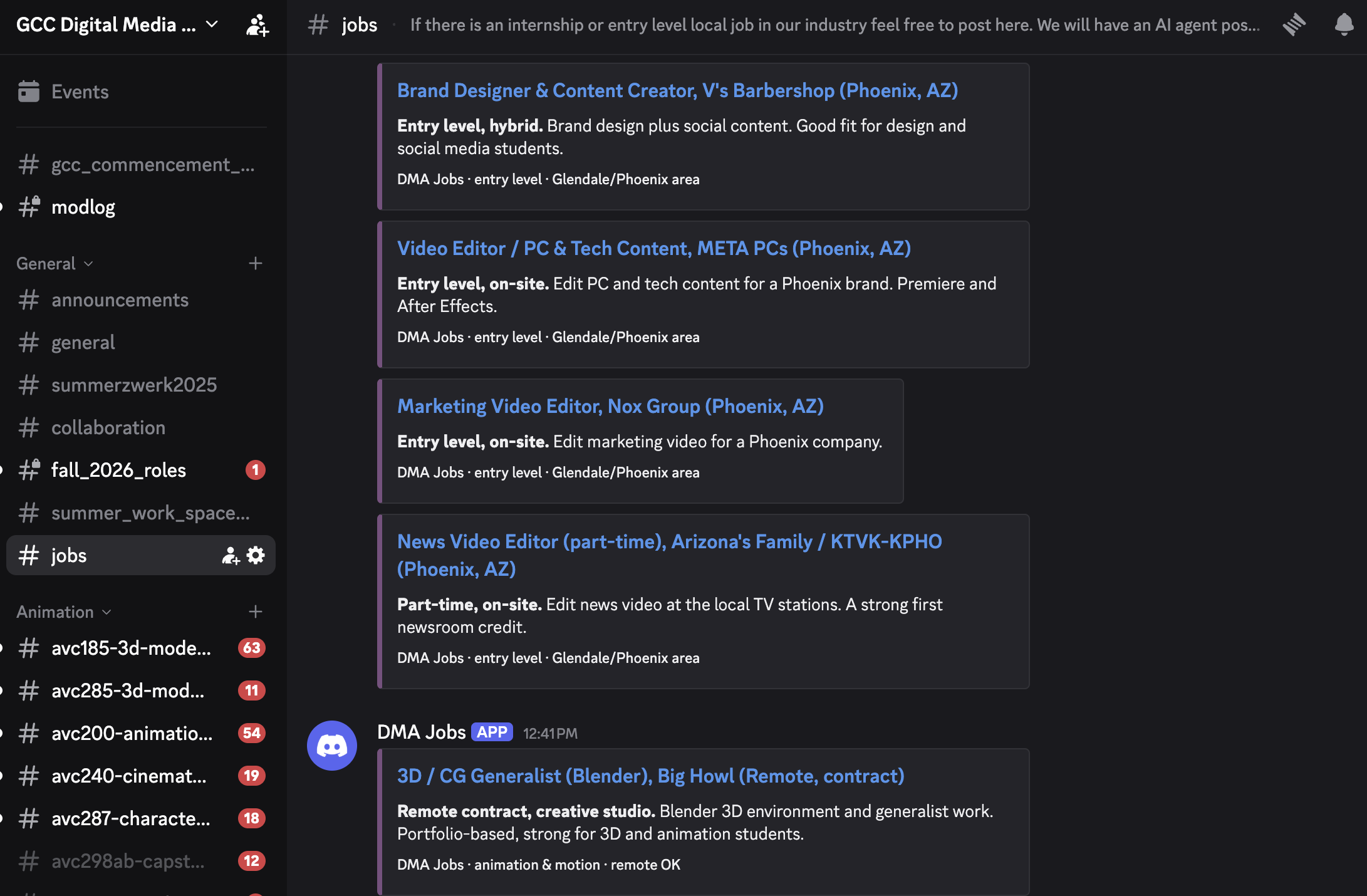
- Jobs board. An AI agent pushes a few new, verified, entry-level jobs and internships in the students’ fields twice a week, the Phoenix area first, remote where the field calls for it, so opportunity comes to them. Career Services workshop links will be added to the board as well.
Connecting a future student-support hub to the community is a planned next step as those resources come online.
Technology
- Discord as the platform, in a closed, invite-only configuration with a FERPA review behind it.
- A jobs agent that posts to the jobs board through a webhook.
Outcomes
Live and in use by the digital media programs. Adoption is the outcome that matters here, and it stuck where earlier tools did not. The measure going forward is engagement and belonging, the factors the community-college retention research ties directly to whether a student stays.